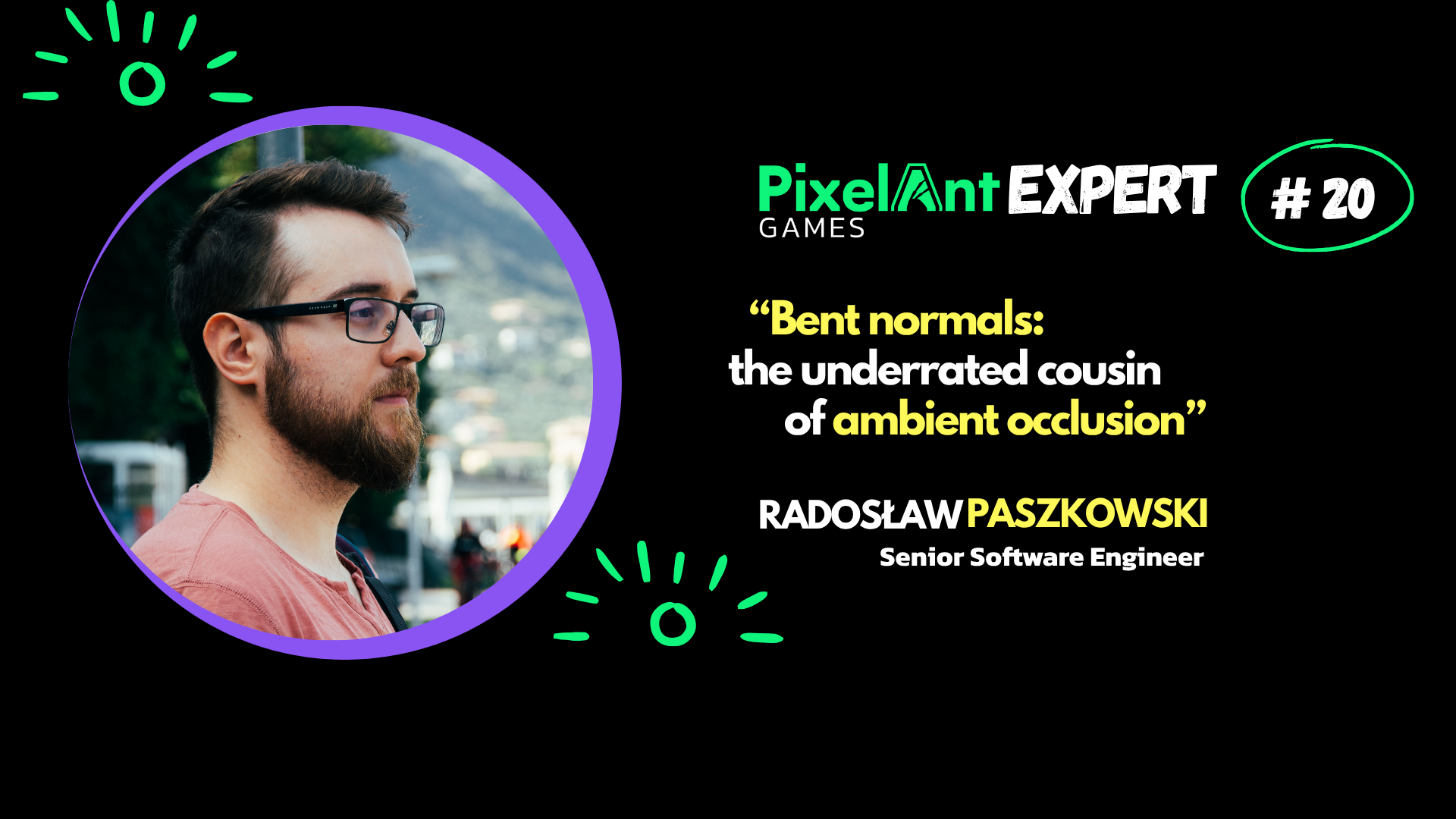
Bent normals: the underrated cousin of ambient occlusion
Bent normals are often overlooked, yet they deliver noticeably better specular lighting at a relatively low cost – no...
read more >>

Did you know your game’s CPU performance could be running 3-6x slower than its potential? While most developers meticulously optimize GPU shaders, significant CPU performance improvements often remain untapped.
In today’s demanding game development landscape, GPU optimization through shader programming is standard practice. Yet many developers overlook a parallel technology for CPU optimization: Intel’s Implicit SPMD Program Compiler (ISPC). This powerful tool functions essentially as “CPU shaders,” enabling similar performance gains on the processor side.
Since Unreal Engine 4.23, ISPC has been integrated directly into the engine, most notably powering the Chaos physics system. The technology enables a specialized C-like programming approach that appears sequential but executes in parallel across CPU cores and vector units – just as GPU shaders do for graphics.
Here’s how dramatic the performance gains can be:
// (.ispc file):
export void vectorAdd (uniform float iA[],
			     uniform float iB[],
               		     uniform float output[],
			     uniform int count)
{
 	foreach (i = 0 ... count)
	{
		output[i] = iA[i] + iB[i];
	}
}
// In C++
void ProcessVectors()
{
ispc::vectorAdd(InputA.GetData(), InputB.GetData(), Output.GetData(), 10000); }
This simple-looking code automatically utilizes SIMD vectorization to process multiple elements simultaneously – comparable to how fragment shaders process multiple pixels.
From my experience implementing ISPC in performance-critical systems:
1. Vector math operations benefit dramatically from ISPC’s parallel processing capabilities, making physics calculations, animation systems, and procedural generation significantly faster.
2. Physics simulations can handle far more objects when ISPC-optimized, as seen in the UE’s own Chaos system, where complex multi-object interactions run efficiently.
3. Image processing routines for runtime texture manipulation (brightness adjustments, filters, masks) become drastically more performant through vectorization.
4. AI calculations involving many entities can be accelerated tremendously, enabling more complex behaviors without framerate penalties.
For developers looking to leverage ISPC in Unreal Engine projects:
Author

Grzegorz Wątroba
Principal Software Engineer
Game programmer since 2010, specializing in designing code architecture, optimization and porting on various platforms. Cooperated with Polish and foreign companies such as Bloober Team, One More Level, Fool’s Theory, Vile Monarch, Covenant.dev or Polygon Treehouse among others. Worked as well on the standard IT market for Nokia, Autodesk and Xara but games turned out to be his true love.